Types of Lace: Chantilly, Guipure, Alençon and Corded
Types of lace explained: Chantilly is fine and airy, Alençon has corded motifs, guipure has no net and corded lace traces the pattern for definition.
このガイドで紹介したドレスを見る


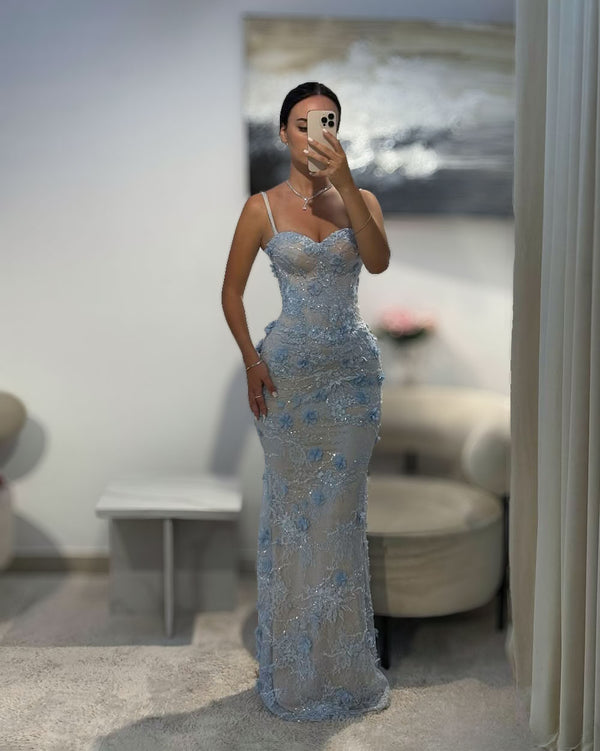

What are the main types of lace? The four you will hear most for formal gowns are Chantilly, a fine and airy lace with delicate floral patterns on a net ground; Alençon, a needle lace whose motifs are outlined with a raised cord; guipure, a heavier lace with no net, where the motifs are joined by small bars; and corded lace, any lace whose pattern is traced with a cord for extra definition. Each one changes how sheer, textured and structured a gown looks.
Lace is one of the oldest decorative textiles in eveningwear, and the word covers a wide family of fabrics. Some are almost transparent and soft enough to drape, while others are firm enough to hold their own shape. Knowing the names helps you describe what you want, read product descriptions with confidence and choose a lace that suits your neckline, silhouette and event. This guide explains each type in plain language and shows how lace is used on corset gowns. To see lace designs, browse our Lace Corset Dresses.
How lace is built: net ground, motifs and edges
Most laces share three parts, and the way they combine defines the type.
- The ground: A fine net or mesh that holds the pattern together. Some laces have one, some do not.
- The motifs: The pattern itself, usually flowers, leaves, scrolls or geometric shapes.
- The edge: A scalloped or eyelash border that finishes the lace at a hem, sleeve or neckline.
When lace sits on a corset gown, it is often layered over a sheer illusion base or a lining, which lets the pattern show clearly while the structure underneath does the shaping.
Chantilly lace
Chantilly is the lace most people picture when they think of a romantic bridal or evening gown. It has a very fine net ground with detailed floral and scroll motifs, often outlined with a slightly thicker thread so the pattern reads clearly. The edges are usually finished with a soft scallop or fine eyelash fringe. Chantilly is light, flexible and semi-sheer, so it drapes well over a fitted bodice, along sleeves and across a flowing skirt.
Best for: Soft, romantic looks, long sleeves, illusion necklines and gowns where you want the lace to feel delicate rather than heavy.
Alençon lace
Alençon is a needle lace, named after the town where it was first made. Its motifs, usually flowers and leaves, are outlined with a raised cord called a cordonnet, which gives each shape a defined, slightly three-dimensional edge. The background is a fine net, and the overall effect is richer and more structured than Chantilly. Alençon is often cut into motifs and appliquéd onto tulle or another lace for a hand-placed look.
Best for: Fitted bodices, defined necklines and gowns where you want the pattern to stand out with clear outlines.
Guipure lace
Guipure has no net ground. Instead, its motifs are connected by small bars or bridges, so the lace has open spaces between the shapes. It is heavier and more textured than net-based laces, with a firm hand that holds its shape. Guipure can look graphic and modern, especially in bold floral or geometric patterns, and it is sometimes called macramé lace.
Best for: Structured silhouettes, statement bodices and designs where texture is the focus rather than transparency.
Corded and re-embroidered lace
Corded lace is any lace whose motifs are traced with a cord or thicker thread after the lace is made. Re-embroidered lace is a similar idea: a fine lace is embellished by hand or machine with cord, ribbon or beads to give it more dimension. Both techniques make the pattern stand out from a distance, which is why they are popular for formal gowns and photographs.
Best for: Gowns that should read clearly in photographs and under evening lighting.
Other lace terms you may see
- Embroidered lace on mesh: A pattern stitched onto a sheer mesh base rather than made as a separate lace. It allows very precise placement around a bodice.
- Floral or 3D lace: Lace with raised petals or appliquéd flowers that stand away from the fabric, adding depth.
- Eyelash lace: Lace finished with fine threads along the edge, like lashes.
- Scalloped edge: A curved border used at hems, sleeves and necklines.
- Lace appliqué: Individual lace motifs cut out and stitched onto another fabric, often tulle.
For how lace compares with satin, tulle and crepe in general, our guide to evening gown fabrics gives an overview.
Lace corset gowns to compare


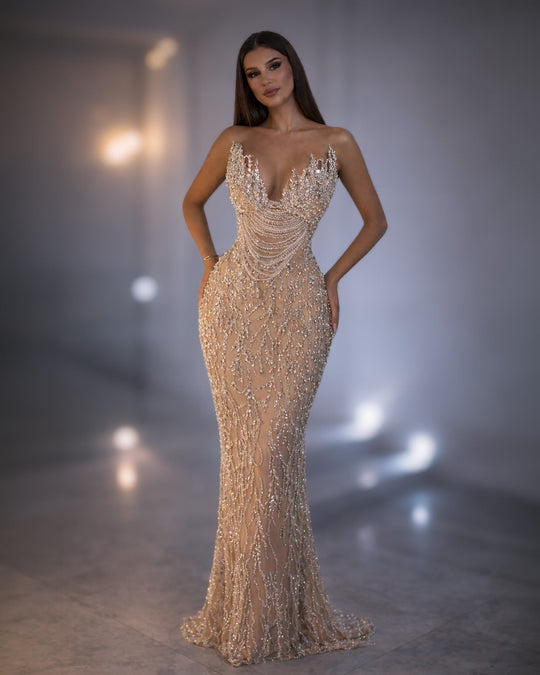
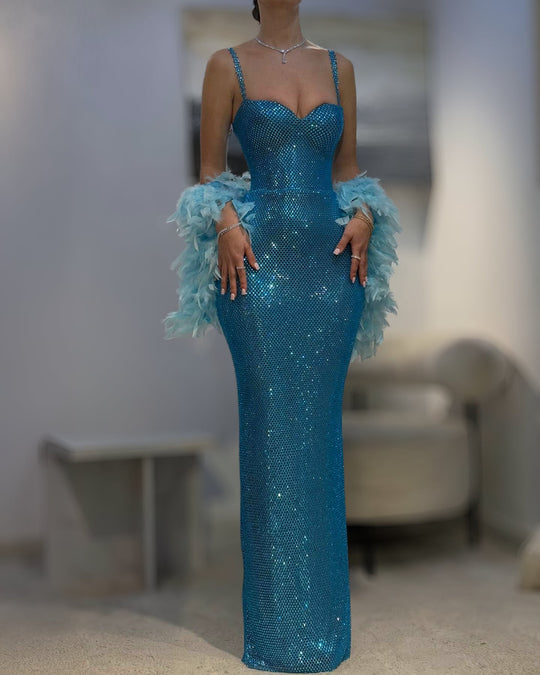
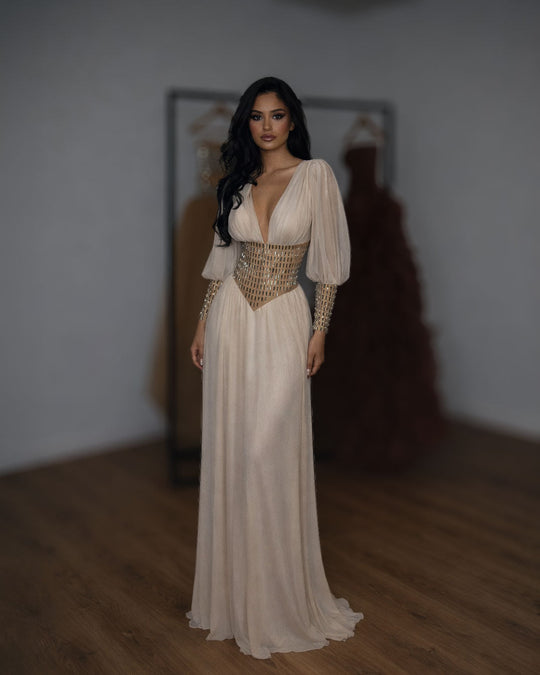
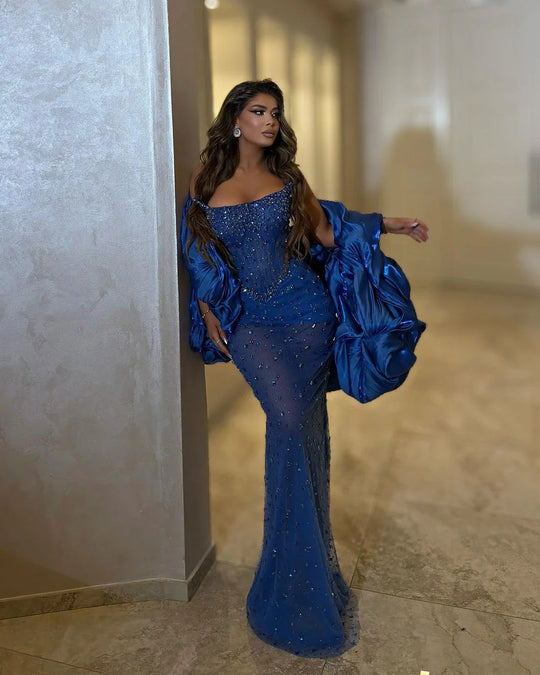
These three show how differently lace can read: embroidery on illusion mesh, an all-over lace layered on a sheer base, and raised floral lace on a mermaid shape. If you would like to know more about the lace on a particular gown, ask our team on WhatsApp. For a closer look at raised flowers against flat lace, see our comparison of 3D floral and lace evening gowns.
Quick comparison
| Type | Ground | Feel | Look |
|---|---|---|---|
| Chantilly | Fine net | Light, soft | Delicate, romantic, semi-sheer |
| Alençon | Fine net | Medium | Defined motifs with a raised cord outline |
| Guipure | None, motifs joined by bars | Heavier, firm | Textured, graphic, open |
| Corded | Varies | Medium | Clear outlines that read from a distance |
How to choose the right lace
Think about the silhouette
A fitted mermaid or column gown suits a lace that follows the body, such as Chantilly or embroidered lace on mesh. A structured, statement bodice can carry a firmer guipure or a corded lace.
Think about transparency
Net-based laces over illusion mesh show more skin through the pattern. If you prefer more coverage, ask about the lining under the lace.
Think about photographs
Corded and raised lace keeps its pattern visible in photographs, while very fine lace can look softer and more blended.
Think about the occasion
Lace works for weddings, galas, proms and formal dinners. Our guide to lace wedding dresses covers the bridal side.
Caring for lace
Lace is delicate, so treat it gently. Steam on a low setting from the inside rather than pressing it with an iron, store the gown flat or loosely folded with acid-free tissue and keep it in a breathable garment bag. Avoid rough jewellery and bags that can catch the threads, and have marks cleaned by a specialist in formalwear.
Ordering a lace gown
Every gown on this page is made to order in 2 to 3 weeks before it ships. A 50% deposit starts your order, and the balance is paid after you approve the final video. We ship to more than 200 countries, and our team answers questions about lace, lining and coverage on WhatsApp at +1 646 204 0913.
Frequently asked questions about types of lace
What is the difference between Chantilly and Alençon lace?
Both have a fine net ground, but Alençon motifs are outlined with a raised cord, which makes them more defined. Chantilly is lighter and softer.
What is guipure lace?
A lace with no net background. Its motifs are joined by small bars, so it is heavier, more textured and holds its shape.
Is lace see-through?
Net-based laces are semi-sheer on their own. On a gown, lace is usually layered over a lining or a sheer illusion base, which controls how much shows through.
Which lace is best for a fitted gown?
Flexible laces such as Chantilly or embroidered lace on mesh follow the body well. Firmer laces such as guipure suit structured shapes.
Can the light blue lace gown be made in ivory?
It is made to order, so another colour can be discussed with our team on WhatsApp at +1 646 204 0913.
Find your lace
From airy and romantic to bold and textured, there is a lace for every silhouette. Explore our Lace Corset Dresses to see lace on structured bodices.
Reinee Couture fabric notes, November 2026.
あわせて読みたい